STEM VR brings science, technology, engineering, and math to life in immersive virtual reality with Sandbox VR, hands-on learning like never before.

par Kimkind Yeung
STEM VR: How Virtual Reality Brings Science, Technology, Engineering, and Math to Life
Traditional screen-based learning expects you to sit still and absorb information. STEM VR, on the other hand, puts you inside the lesson. Instead of reading about scientific concepts, you experience them through movement, interaction, and shared exploration with hands-on experiences.
At Sandbox VR, our immersive experiences make that full-body engagement happen naturally. Through STEM VR, we’re reshaping curiosity and comprehension for learners of all ages while helping them build confidence around technology.
Table of Contents
What Is STEM VR And Why Does It Matter Right Now?
How Does Virtual Reality Support STEM Learning?
Can VR Experiences Actually Spark Curiosity In Young Learners?
Spotlight: What Makes Age Of Dinosaurs A STEM VR Experience?
How Does Sandbox VR’s Technology Bring STEM Concepts To Life?
Who Benefits Most From STEM VR Experiences?
How Do You Get Started With An Experience At Sandbox VR?
What Is STEM VR And Why Does It Matter Right Now?
STEM VR combines virtual reality education with the core STEM disciplines of science, technology, engineering, and math. It transforms concepts that might feel abstract on the page, such as physics, biology, or engineering logic, into interactive environments you can explore, giving learners direct access to complex ideas.
Traditional STEM education often struggles to engage students. They read, watch, and listen, but they don’t always connect with the material. Screen time doesn’t draw them in; these students crave active, participatory experiences. They favor immersive learning that invites physical involvement and critical thinking.
This prevalence of such hands-on learners has pushed educators and program leaders to seek more hands-on learning approaches. Schools, camps, and enrichment programs have started adopting immersive learning tools that encourage movement, collaboration, and exploration using dynamic VR content.
That’s where STEM VR excels. When students step into a VR environment, complex ideas like physics, spatial relationships, and biological systems become tangible and interactive.
How Does Virtual Reality Support STEM Learning?
VR creates an environment in which learning happens through action. Instead of memorizing concepts, educational VR experiences invite you to apply them in real time in a practical way.
Spatial Reasoning and Physics in Motion
When you physically move through virtual worlds, your mind develops an intuitive grasp of scale, perspective, and spatial relationships. Concepts like geometry, distance, and proportion stop feeling abstract as you examine the way they work all around you.
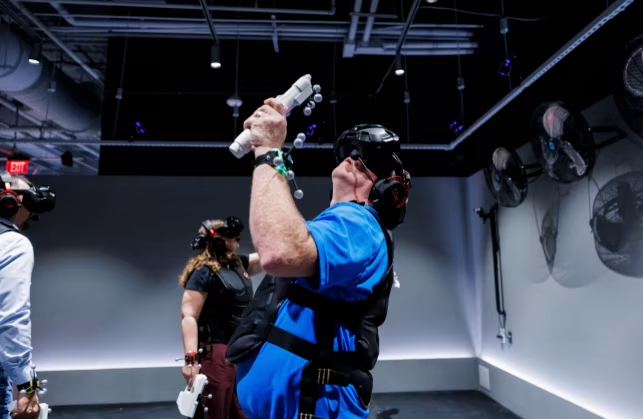
During a Sandbox VR experience, our full-body motion capture technology translates your real-world physical movements into real-time virtual responses. As you step forward, reach out, or duck behind an obstacle, your avatar responds instantly by moving exactly as you do. It’s a hands-on, intuitive physics lesson without a lecture, strengthening real-world understanding.
Problem-Solving Under Pressure
Immersive VR experiences require real-time critical thinking and decision-making. You'll assess your surroundings, adapt your strategies, and troubleshoot issues on the fly, all of which are core STEM thinking skills that prepare learners for the future.
Plus, because you’re facing these challenges in a group, you’ll also work on your communication and collaboration skills while solving problems. Compare that to the solo classwork students often do in isolation, and you’ll see how VR adds multiple layers of learning.

Technology Literacy Through Experience
Spending time in a VR environment builds familiarity with and fluency in emerging technology, expanding knowledge of how systems work. As you interact with motion tracking sensors, haptic feedback, and responsive virtual environments, that direct experience with STEM learning technology makes education feel intuitive rather than intimidating.
Can VR Experiences Actually Spark Curiosity In Young Learners?
Emotion and memory are powerful learning anchors.
Passive instruction, such as reading a textbook paragraph or listening to a teacher talk, doesn’t necessarily stick with you, but active learning experiences often naturally spark curiosity. When a child dodges a dinosaur or collaborates with friends to solve a challenge in the virtual world, the experience creates a strong emotional response. Those moments embed themselves in the child’s memory and drive additional questions, interest, and exploration.
For tapping into emotions, immersive learning stands out from other methods. Educational VR experiences connect emotion with information, making the material easier to remember and more engaging to revisit.
Sandbox VR experiences are designed around group interaction and collaboration, which makes learning social, memorable, and emotionally resonant.
VR learning for kids can also be an entry point into a STEM identity. When kids find themselves solving problems, reacting quickly, and working as part of a team, they begin to picture themselves in STEM-related roles, such as scientists, engineers, and technologists. These realizations can be formative for children just coming into who they are.
Spotlight: What Makes Age of Dinosaurs A STEM VR Experience?
Our Age of Dinosaurs experience is an excellent example of immersive STEM learning in action. Instead of simply presenting facts about prehistoric life, it drops you right into the middle of the dinosaur era, where you explore an environment shaped by paleontology, prehistoric biology, and natural history.
Instead of reading about dinosaurs or watching them on a screen, you see them all around you, changing how you perceive these titanic creatures and how you engage with the subject. Full-body motion capture, haptic feedback, spatial audio, and cinematic visuals make you feel as if you’re truly inside the world of the dinosaurs. And beyond watching events unfold, you become part of them and react to them in real time.

Groups of up to six people share the same adventure. Because you and your teammates collaborate, communicate, navigate, and adapt together, this type of immersive experience reinforces teamwork along with STEM themes. The format works well for school groups, science camps, family outings with curious kids, and educators seeking experiential field trip alternatives.
“It’s not a lesson about dinosaurs. It’s an encounter with them.”
How Does Sandbox VR’s Technology Bring STEM Concepts To Life?
The technology behind our experiences is an essential part of how they teach and engage learners.
Full-Body Motion Capture
Our motion capture sensors track your movements and translate them into the virtual world in real time. Your digital avatar mirrors your every step, turn, and gesture.
Motion capture connects to concepts in biomechanics, computer science, and animation, adding another layer to STEM learning by showing you how digital systems can interpret physical movement. During your adventure, you witness firsthand the results of engineering and coding decisions that real technologists make when developing our experiences.

Haptic Feedback and Sensory Information
Haptic feedback introduces ideas from sensory science, electrical engineering, and human-computer interaction.
Our haptic vests provide physical feedback, allowing you to actually feel and hear what happens in the digital world. Vibrations from gargantuan reptiles walking nearby might make your feet quiver, or you might hear the breeze blowing off the prehistoric sea. Unlike passive screen time, the fully immersive experience lets your body become part of the learning process.
Shared Virtual Environments
STEM VR is a perfect example of how networked systems, collaborative technology, and communication design work together.
During a Sandbox VR experience, up to six participants share the same virtual space. You'll see each other’s avatars, hear each other's voices, and interact with your team in real time. And participation and full immersion in the environment will transform your shared experience into lasting shared memories.
Who Benefits Most From STEM VR Experiences?
Various groups connect with STEM VR in different ways.
School-age children and teens: This is the ideal range for building STEM identity and curiosity. VR learning for kids meets them at the point when engagement is highest and encourages curiosity through action.
Educators and camp directors: STEM VR is a compelling alternative to traditional field trips or passive educational media. They combine movement, collaboration, and social interaction into experiential learning.
Families: Learning doesn’t have to feel like school. These shared immersive experiences create conversation, curiosity, and connection.
Corporate and team groups: Teams practice problem-solving and communication in real time, helping build workplace STEM skills.
How Do You Get Started With An Experience At Sandbox VR?
It couldn’t be simpler: You can book a session online, select your time slot, and arrive with your group. Each experience accommodates up to six people. Our staff guides you through the setup process, helps you gear up, and explains how it works before your session begins. We provide the equipment, and no prior VR experience is required.
We recommend Age of Dinosaurs as a starting point for STEM-focused school groups, families, and anyone interested in a science-focused experience.
Come as a group. Leave with a story.
Spark Curiosity With STEM VR
By combining immersive experiences with real-time interaction, STEM VR brings science and technology to life in a memorable, engaging way. Book an experience at Sandbox VR today, and see how curiosity takes shape when you’re part of the action.
FAQs
Is STEM VR suitable for young learners?
Yes, when content is age-appropriate and guided.
Can VR replace traditional STEM education?
No, it complements and enhances learning.
Does VR education encourage teamwork?
Yes, many experiences emphasize collaboration.
Are immersive experiences only for entertainment?
No, they also support learning and skill development.
Can schools use VR for classroom learning?
Yes, many institutions integrate VR for interactive education.
Autres articles
What Is Full-Body Tracking VR?
Full-body tracking VR transforms how you play. Discover the technology powering Sandbox VR's hyper-immersive, full-body virtual reality experiences.

VR Arcade Near Me
Searching for a VR arcade near me? Discover how VR arcades have evolved into fully immersive, multiplayer experiences at Sandbox VR locations.
