Full-body tracking VR transforms how you play. Discover the technology powering Sandbox VR's hyper-immersive, full-body virtual reality experiences.

par Kimkind Yeung
What Is Full-Body Tracking VR? The Tech Behind Immersive Gameplay
We often hear that virtual reality, or VR, places you in the action, but this is most true of full-body tracking VR. This technology uses sensors to capture the wearer's every movement and body motion to create an environment that is both immersive and responsive. While OST VR puts a world in front of you, full-body tracking VR brings you into that world.
Keep reading to learn more about full-body tracking VR: how it works, why it's different, and how Sandbox VR uses it to bring virtual worlds to life through advanced software.
Table of Contents
What Is Full-Body Tracking VR?
How Does a Full-Body VR Tracking System Work?
What Makes Full-Body Tracking Different From Standard VR?
Why Does Full-Body Tracking Make Experiences More Immersive?
What Equipment Is Used In A Full-Body Tracking VR Experience?
How Does Sandbox VR Use Full-Body Tracking Technology?
Is Full-Body Tracking VR Right For Everyone?
What Is Full-Body Tracking VR?
VR motion tracking is sometimes also referred to as a VR tracking system or full-body tracking VR. You might be more familiar with standard VR, which often consists of only a headset or handheld controller. This limits what you're able to do and see in a virtual world.
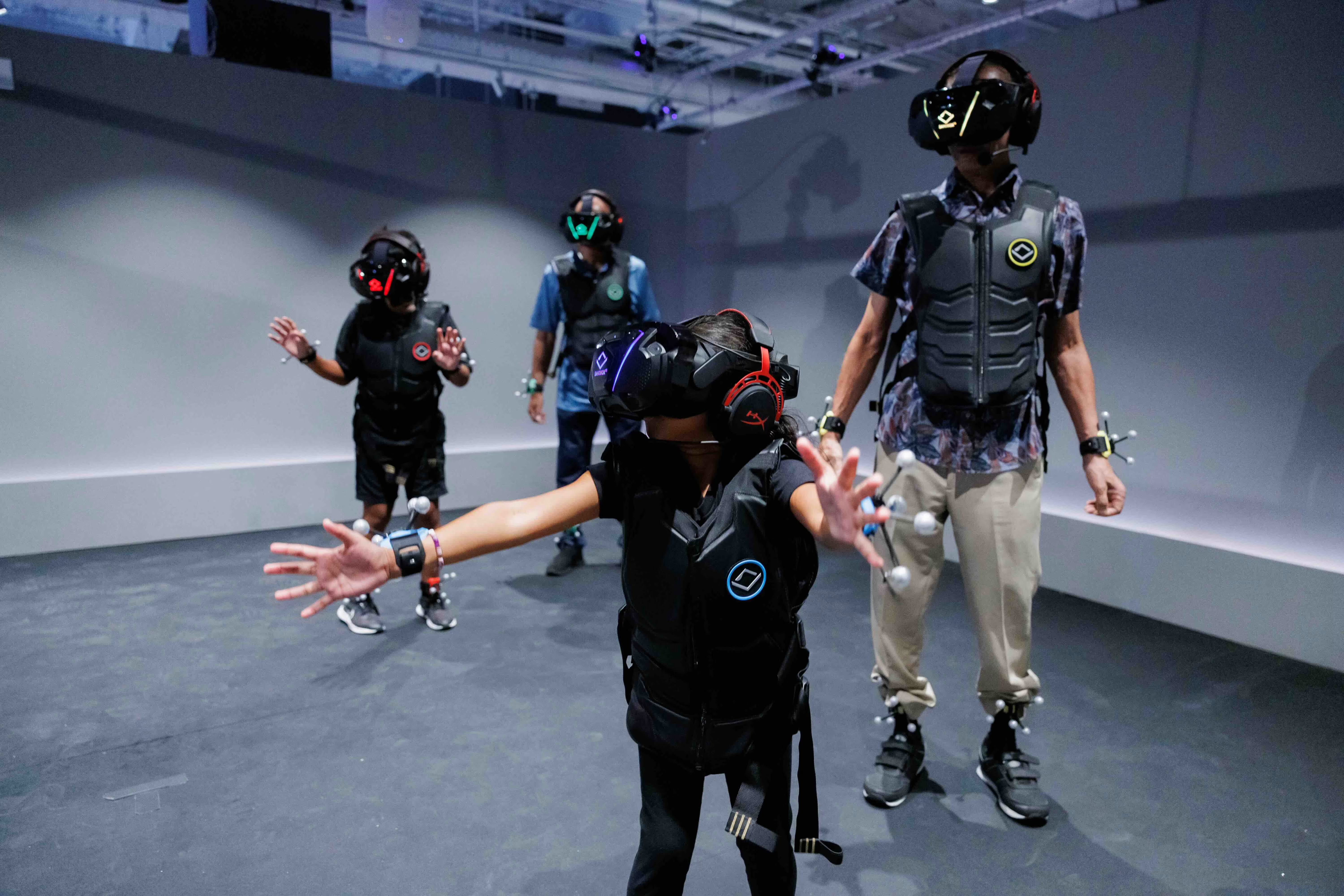
Full-body tracking VR is different because it captures your every movement, from your head to your feet. Because of the extra sensors, teammates can see each other's avatars moving around and interact with them in real time. These sensors also capture the user's position with greater accuracy; this is called absolute positioning. These aspects make full-body tracking ideal for groups that want to adventure together in the same physical space, connected in real-time.
How Does a Full-Body VR Tracking System Work?
Sensors and Trackers
VR tracking sensors are placed on the wearer's head, wrists, and ankles. The last one is rarely seen in consumer VR, so it's what sets full-body tracking virtual reality apart. Multiple sensors all over the body work together to map the skeleton used to create an avatar. This avatar represents you in the virtual world.

Absolute Positioning
Most VR setups rely on relative positioning, which guesses where the wearer is based on a single sensor. In contrast, because full-body VR uses multiple trackers, it can use precise absolute positioning to reduce drift. This is how full-body VR can pinpoint exactly where you are and what you're doing, making it easy for teammates to see and interact with each other without accidental collisions.
Motion Capture Technology
Full-body tracking used to be reserved for blockbuster movies and video games with billion-dollar budgets. Now, the VR tech developed to bring those characters to life is your ticket to far-off worlds. Your avatar moves as you do. It touches your teammates when you reach out. Your teammates look for it to find you. Every movement you make is recreated 1:1 in real time.
What Makes Full-Body Tracking Different From Standard VR?
The difference between the two is apparent when you jump in. Here's what you probably get with standard VR, compared with what full-body VR provides:
Standard VR | Full-Body Tracking VR |
Floating hands that are disconnected from you | Complete avatar embodiment from head to toe |
Limited presence in your surroundings | Spatial awareness of others |
A solitary experience by default | Physical interaction with teammates |
With full-body VR, you are your own pilot, your surroundings are believable, and your choices matter.
You can wave, point, crouch, and dodge, and the system will enhance and register your actions in real time.
Your teammates appear as full avatars of their own instead of disembodied heads.
The physical space you occupy is shared and respected by the system.
Haptic feedback provides a physical response to your interactions, working with motion tracking to create a world you can both see and feel.
You might have used standard VR and seen a digital world through the headset. Now imagine entering that world as a fully mobile avatar, feeling events unfold around you, and seeing your friends or family at your side. This is the difference between standard VR and a full-body VR experience.
Why Does Full-Body Tracking Make Experiences More Immersive?
The Role of Physical Presence
Proprioception is your brain's sense of where your body is. If you raise your leg in front of you but can't see it, your brain knows that something's off. This prevents you from being truly immersed in VR systems that don't account for your every movement.
With full-body tracking, virtual reality feels like reality. When virtual reality confirms what your body feels, you feel like you belong in that world.
Social Immersion and Shared Memory-Making
VR is a fun solo experience, but it becomes something more when shared with others. Full-body VR goes beyond just being able to see each other; you can read their body language, gestures, and reactions as you explore the same adventure. It becomes a shared memory, complete with a story to tell afterward.
The experiences offered at Sandbox VR don't lack variety. We have zombies, dinosaurs, Squid Game, Stranger Things, and more, and each world is yours to engage with.

What Equipment Is Used In A Full-Body Tracking VR Experience?
The list of required equipment is short but comprehensive:
Headset
Wrist sensors
Ankle sensors
Haptic vest
Wrist and ankle sensors capture your movement perfectly, which is a key component of full-body tracking VR. Our environmental features, like fans, are triggered by certain in-game actions to add even greater depth to the player experience. No prior VR familiarity is needed to gear up; all of your equipment is fitted on arrival.
Our system is designed for up to six people to use simultaneously, and the physical space is built for free movement. You don't need to worry about running into barriers, cables, or anything else.
How Does Sandbox VR Use Full-Body Tracking Technology?
A Purpose-Built Immersive VR Technology Platform
At Sandbox VR, we know that an immersive experience requires more than putting on a store-bought headset. It requires motion tracking, haptic feedback, and spatial audio working together to bring you into the digital universe. That's why we designed our tracking platform specifically for location-based group experiences.
From Physical Movement to Virtual Action
An enemy charges at you, but you dodge just in time. You catch a glimpse of your teammate, who is ready to help you take it down. You both nod, then open fire, holding your guns tight as they recoil. Victorious, you and your teammate high-five in celebration.

This is possible because the sensors you're wearing pick up your every move, then process it so your avatar performs those actions in real time. Our haptic feedback systems respond to what's happening in the virtual world. Our systems are high-quality and low-latency, so your avatar is truly an extension of you.
Experiences Designed Around the Technology
Our narrative experiences are not retrofitted for full-body interaction but built for it from the very start. The core pillars of our design are physical reactions, group dynamics, and spatial teamwork. This results in experiences that feel cinematic rather than arcade-like.
Is Full-Body Tracking VR Right for Everyone?
Never used VR? No problem! If you're looking to try full-body tracking, Sandbox VR is the most accessible entry point. No experience is required, and we accommodate a wide range of ages and physical abilities.
Up to six people can enjoy an experience together. This makes Sandbox VR ideal for:
Friends
Families
Dates
And more!
Our experiences are both varied and easy to jump into, making each one a great way to build lasting memories together.
Social Experience Evolved
When motion capture, sensor technology, and spatial computing combine, full-body tracking VR is the result. This allows for not only better visuals, but genuine physical and social presence between teammates. One can't help but wonder how shared experiences will continue to evolve in the near future.
Curious what worlds await you? Book an experience at a Sandbox VR location near you and jump in!
FAQs
Is full-body tracking VR different from regular VR?
Yes, full-body tracking VR maps your entire body into the virtual world, while standard VR typically only tracks your head and hands.
Do I need experience with VR to try a full-body tracking experience at Sandbox VR?
No, Sandbox VR experiences are designed for all comfort levels, and staff members guide guests through setup before every session.
Does full-body tracking VR require ankle trackers?
Yes, ankle tracking is essential to accurately capture lower-body movement and complete the full-body avatar.
Can multiple people use full-body tracking VR at the same time?
Yes, Sandbox VR supports groups of up to six people, all tracked simultaneously in a shared virtual space.
Is full-body tracking VR safe?
Yes, the system uses absolute positioning to maintain awareness of every participant's location, keeping the physical experience safe throughout.
Autres articles
STEM VR: Learning In Virtual Reality
STEM VR brings science, technology, engineering, and math to life in immersive virtual reality with Sandbox VR, hands-on learning like never before.

VR Arcade Near Me
Searching for a VR arcade near me? Discover how VR arcades have evolved into fully immersive, multiplayer experiences at Sandbox VR locations.
